Every morning Shaban Mtila pushes his motorboat into Chia Lagoon in Nkhotakota District, it meets resistance not from harsh winds or waves, but thick, drifting vegetation that has clogged the waterbody.
Floating plants have choked what were once open channels for the fisherfolk. In many stretches, the fisher’s boat cannot pass at all.
Mtila and his crew have to navigate the green blockade every day.
“The situation affects our fishing community, including our work as a conservation group. Blocked routes hinder us from tracking what is happening in the fish and bird sanctuaries,” he laments.
Mtila also leads Chia Bird Hunters Association in villages surrounding Malawi’s largest lagoon where massive overgrowth have blocked fishing routes and bridges, disrupting conservation patrols and livelihoods.
On land, the consequences are just as severe. Fields that once absorbed seasonal water are submerging and maturing cassava is rotting beneath the waterlogged soil.
Nearby, rice paddies have turned into stagnant pools. The water that sustained the staple is now smothering it.
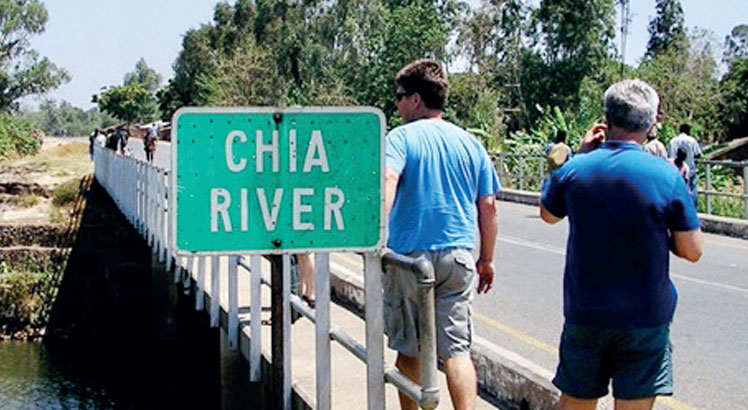
The floating green islands have created a chokepoint beneath Chia Bridge on the M5 along the sandy shoreline of Lake Malawi.
The drifting plants, roots and debris have formed a dense, compact mass since February rains, when locals first sighted scattered vegetation in their prized fishing and birding ground surrounded by cassava and rice fields.
“The floating islands clogging the bridge restrict water flow from the lagoon to the lake, causing flooding in surrounding communities,” says Nkhotakota district environmental officer Jane Kaira.
The blockage has placed a critical piece of infrastructure under strain.
As swelling water forces the floating masses hard against the bridge’s pillars, pressure builds and narrows the passage further.
The longer the mass sticks under the bridge, the greater the risk of structural weakening or failure.
Meanwhile, debris keeps accumulating, posing a threat to the vital bridge on the shortcut between the Southern and Northern regions, a gateway to the country’s largest tourist attraction and fishing ground. The M5 is also also a conduit for truckloads of sugar from Dwangwa cane plantation.
The overgrowth also triggers a cascading ecological disruption.
According to Kaira, the floating vegetation is part of life on the lagoon.
“They filter nutrients, support aquatic life, sustain bird habitats and maintain water quality,” she says.
However, they slow the water flow and suppress oxygen circulation when trapped and compressed.
The nutrients they once absorbed build up and are released back into water as vegetation decays. This marks a gradual degradation of a self-regulated ecosystem.
The build-up disrupts fish breeding patterns and nature sanctuaries as the delicate ecological balance that supports biodiversity and human livelihoods breaks down.
“As a district council, we have alerted the Roads Authority [RA]. We are waiting for a formal response on a safe and technically sound intervention plan,” Kaira says.
In an interview, RA spokesperson Laurent Kumchenga says the State agency has deployed a contractor to clear the mess under the bridge.
“We have deployed CR20 [a Chinese construction company] to remove vegetation debris and address any potential damage to the bridge approaches. Works on rehabilitating the approaches are already underway under the supervision of Afrisa,” he told The Nation.
Nevertheless, on the lagoon where Mtila works, the thick vegetation choking the water flow is not waning. It keeps choking the channel under the bridge.
Chia Lagoon, which covers some 17 square kilometres, receives water from rivers that flow from Ntchisi hills and pours into Africa’s third-largest freshwater lake.
Uninterrupted movement of water between land, lagoon and lake sustains vibrant agricultural, fishing and biodiversity conservation activity.
For Mtila, the slowdown in water flows means restricted movement across the lagoon, no easy access to fish and bird sanctuaries he helps protect.
The water he depends on has become an obstacle.
The blocked water under the bridge sends a clear message: This is no longer just an environmental problem or an infrastructure issue, but a life-sustaining system under strain.
According to the Wildlife and Environmental Society of Malawi, the 1700-hectare lagoon is part of a 989-square-kilometre wetland that sustains the livelihoods of over 7 800 households comprising at least 30 000 people.